

In 2013 David Graeber coined the term “bullshit job.” I’m a big fan because it’s a super fun phrase to bring up in conversation; nearly everyone nods in agreement and then rambles off a few of their coworkers as examples. “I honestly have no idea what they do,” we all say of the same people. Of course, the pointless email job or the secretary who browses Facebook all day is obvious to everyone, but Graeber expands the category to even more widespread bullshit: the jobs that have no reason to even exist in the first place. From lobbyists to telemarketers to private equity to marketing, he makes the case that these are jobs that exist solely because of market structure failures.
Think of the military. The only reason a country needs one is that other countries have one. If each of the nations could just agree not to have them, everyone would be better off. Each country could spend its military budget building roads, hiring more teachers, funding research, or literally anything else, and society would improve. And it’s not just government. Corporate lawyers, marketing divisions, lobbyists, sales, and plenty of other job categories exist for the same reason. If your competitor has one, you need one too. The entire economy wastes enormous amounts of resources doing things we wouldn’t need to do if everyone could just agree to stop.
I’m guessing you can see where I’m going with this. AI doesn’t help this problem. In fact, we’re actually just looking to replace the one benefit of this phenomenon—a jobs program—with compute.
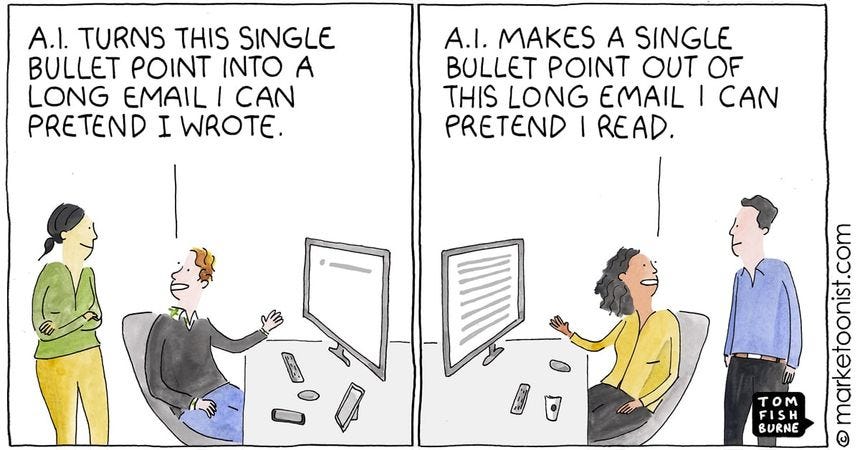
AI bullshitification not only exacerbates problems at the corporate level, it also individualizes the market structure failure. Take writing, for example. Over the past few years, we’ve all seen the gradual creep of AI slop into our feeds. From articles and tweets to even YouTube videos and music, the slop epidemic is here, and, besides a few chuckles at AI novelty, very few people are fans.
As a result, companies and consumers are finding ways to combat the problem. Almost always, though, it means applying a filter in the form of another bot. “An agent to filter spam” or “better AI detection,” all in an attempt to force the manual effort of humans back into the content creation process. Predictably, though, it’s nearly always followed by more advanced content bots or methods that get around these filters. The AI gets better, the compute spend goes up, and the cycle continues. More security bots and filtering agents are added. In the end, we read a normal feed with some spam.
The problem isn’t that garbage content is posted or that people all of a sudden want to post spam (this has always been the case). The issue lies in the automation of it. We’ve always had spam filters on our emails, but now it’s getting better. The cost of the filter is going up. The company spends more and the bots spend more, all for the goal of no one noticing a difference.
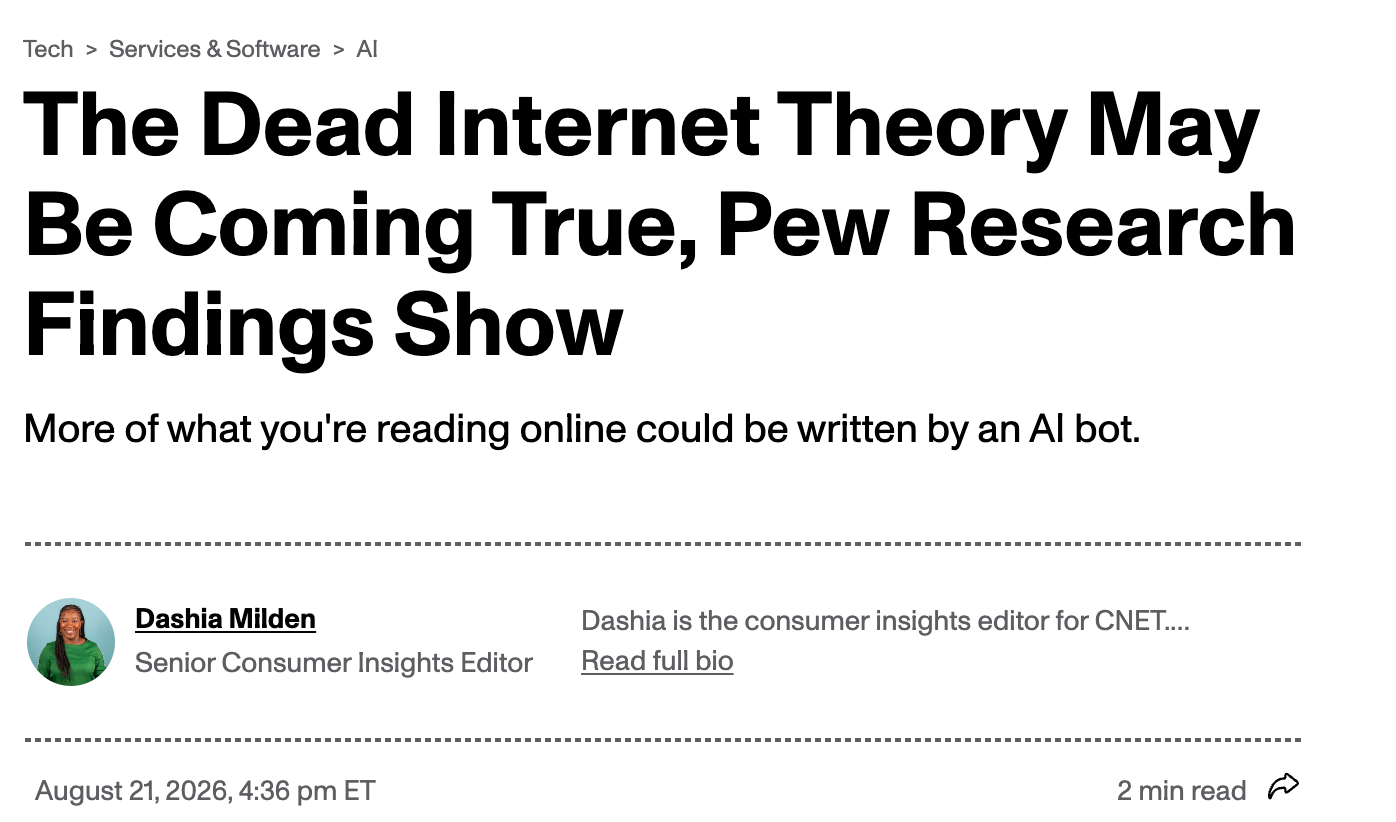
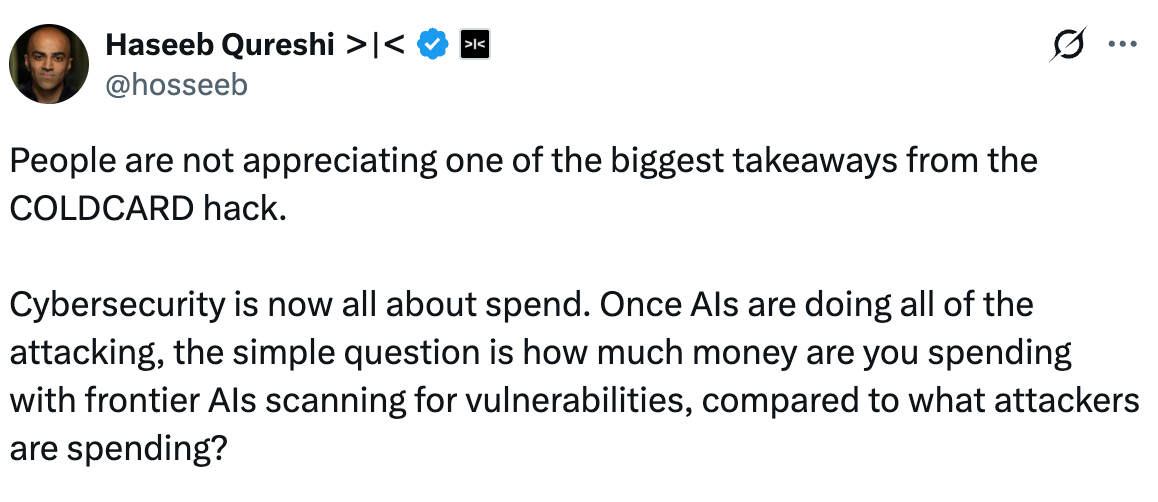
Much of this hearkens back to the “dead internet theory.” The conspiracy stated that most of the internet was just bot traffic and fake people. It’s sort of the digital solipsism that tends to attract the truly narcissistic doomers. But to be fair, it’s turning out to be partly correct. The more accurate prediction, though, might just be that we all have to pay more and more to keep things the same. Just as you’ll have to pay an agent to filter out bots in order to keep your Facebook feed clean, every sector will have to pay the AI gods in order to avoid being outcompeted by someone spending money on more compute.
Marketing will transform into spending tokens writing articles, producing podcasts, and doing whatever it takes to convince an AI to recommend a given product. Instead of paying for ads on websites, no one will go to websites, so the goal will be convincing the bot. Throw money into the AI hole. Whoever throws in more money wins.
Of course, just like with the death of Google search, consumers will need to run their own agents in search of the “real” recommendation. So, they’ll throw money in the hole too. The end result looks a lot like yesterday’s ad-free Google results, just far more expensive to produce.
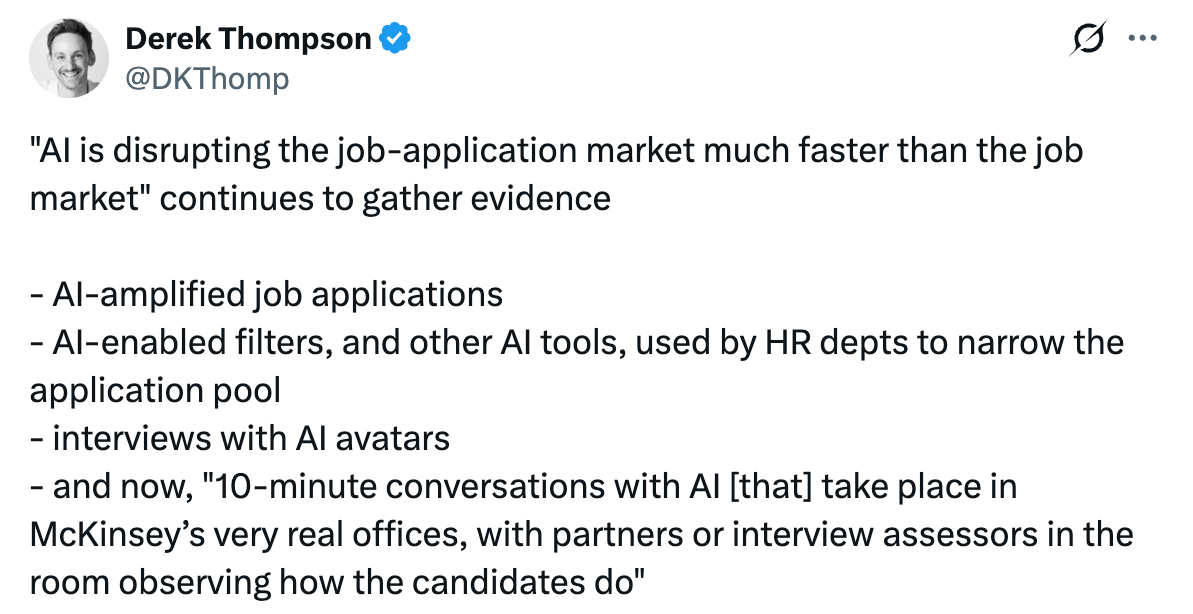
For hiring and recruiting, I think we’re already at a breaking point. Job seekers employ AI to generate hundreds of custom resumes. Employers then run their own filters to weed out all of applications written with AI. Job seekers up their game and work to get around the employer filters. The cycle continues, and we wonder why the founder’s sister is the only one getting hired.
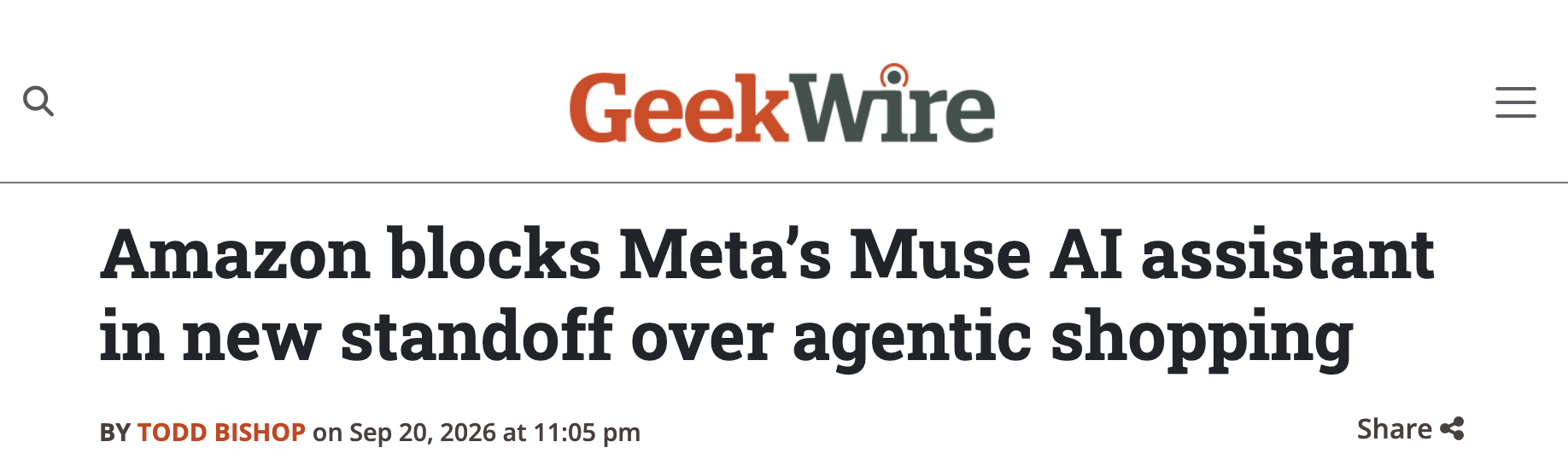
This sort of competition between consumer and company bots is happening everywhere. We’ve all seen the stories of companies like Amazon or Instacart using algorithmic prices (charging you more if they predict you’ll pay it). Luckily though, there’s an obvious defense: your own AI price checks on your behalf! Now your AI can fight the store’s AI. Both sides will keep upgrading their models, and the end state will demand wasting money on compute and a higher price for those who refuse to play the game.
Hopefully you can see now it’s all bullshit. AI promises to improve your bottom line, but if it’s done in a way that has zero value-add, it’s just an extra cost for the economy. If the standard for companies moves from marketing, sales, and some developers to AI marketing, AI sales, and one dev with a coding agent, the company wastes the same amount of money, just with fewer jobs and more data centers. If the customer has to use their own AI to combat the extraction, the game theoretic outcome is even worse.
The only real option if you don’t want to play is to just stop that activity altogether. Some of you might be cheering this outcome, and the Kaczynski in me feels similar, but we should definitely pay attention to what it actually looks like.
If everyone stops using online resumes and we go back to referral-only hiring, who does this help? If open-source software really is dead because of AI hacks, who does this help? If all social media is abandoned in favor of private group chats, who loses?
In each case, the person with connections does better. The internet opened doors and flattened access, but now it’s falling back to reputation or whoever can pay the most for compute.
Yes, turning off our screens might be better. No more social media and more in-person job applications might be a welcome improvement for many of us. Unfortunately, though, having large portions of society fall back to a good-ol boys club is probably not the AI dream that most of us had. If the oligarchs who control the compute infrastructure can extract rent from every sector, it might be the only option.
But to end on a positive note, there are good pieces to the tech, and there are also ways to stop this. That said, we need to be careful how it interacts with our existing systems. Local maxima push us into weird and suboptimal equilibria. Finding the institutional guidelines and structure that can pull us out of them will be a challenge.
Let’s all at least agree that we don’t want to play this game.